
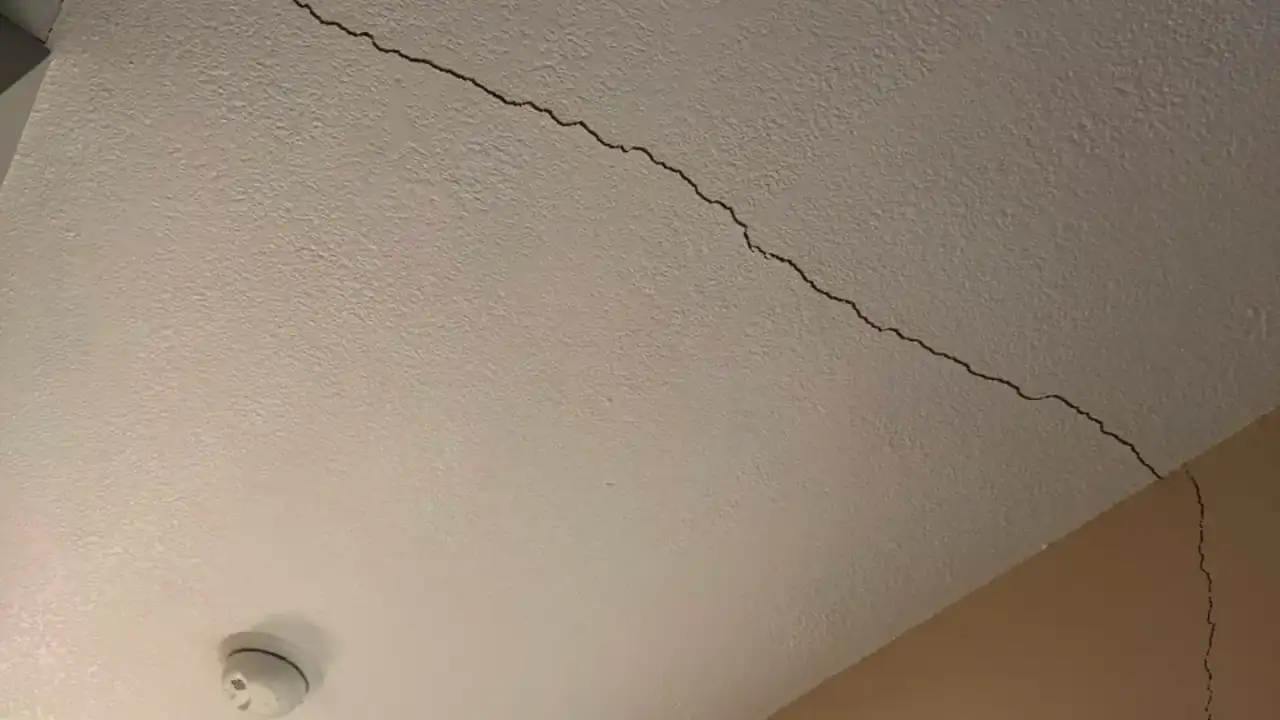
Signs you need this
- • A ceiling that visibly bellies or dips between joists, sometimes with a hairline seam opening at a butt joint
- • A brown or yellow ring, often with a darker halo, that keeps reappearing or slowly spreading after a hard winter
- • Original lath-and-plaster ceilings losing their key, so the plaster separates from the wood lath and starts to drop grit or crack in a spiderweb pattern
- • Cracking that follows the ceiling-to-wall seam or radiates from a light fixture or vent
What a Sagging or Stained Ceiling Is Actually Telling You
A ceiling doesn’t sag or stain for no reason. In Springfield, the two most common causes are a slow water source above the ceiling and, in the city’s older housing stock, a lath-and-plaster ceiling that has started to lose its mechanical bond. Both look similar from below: a dip, a stain, a hairline crack that keeps widening. They are not the same repair, and treating one like the other is how a homeowner ends up paying twice.
Reading a Water-Stained Ceiling
A brown or yellow ring on a ceiling means water moved through the assembly and left dissolved minerals and tannins behind once it dried. If the ring keeps spreading or coming back after repainting, the source is still active. Century-old plumbing stacks, ice-dam-prone rooflines, and Connecticut River valley humidity all feed this pattern in Springfield homes: a slow supply-line drip inside a wall cavity, a roof valley that backs up under a winter ice dam, or condensation off ductwork in an unconditioned attic. Before Springfield Elite Drywall & Plaster opens the ceiling, moisture content in the board or plaster gets checked against the surrounding dry area. Closing up a ceiling over material still holding moisture just traps it and sets up mold growth in the cavity, which is a callback nobody wants.
Why Plaster Ceilings Fail Differently Than Drywall
Forest Park’s 1890–1925 housing stock, along with much of the McKnight Historic District’s Victorian-era homes, was built with lath-and-plaster ceilings: wood strips (lath) with plaster keyed through the gaps and hardened as a mechanical lock. Over a century, that key breaks down from vibration, age, and moisture cycling, and the plaster can separate from the lath in sheets even when the surface paint looks intact. A drywall ceiling sags because the gypsum core has softened from moisture or the fasteners have pulled through the paper facing. A plaster ceiling sags because the key itself has failed structurally, which is a different failure mode and calls for a different fix: sound plaster with a failing key can sometimes be stabilized with plaster washers and a skim coat, while plaster that has lost structural integrity across a wider area needs to come down and be replaced, often with drywall, in what’s typically called a plaster-to-drywall conversion.
The Repair Sequence
Once the source is confirmed dry (or was never wet, in the case of an aging plaster ceiling with no leak history), the damaged section is cut back to sound material. For drywall, that means cutting to the nearest framing member so the patch has something solid to fasten to. For plaster, it can mean removing a section down to sound lath, or removing the lath entirely if it’s compromised, then framing in new blocking as needed. New board or a plaster skim coat goes in next, and this is where texture matching matters: Springfield ceilings show a mix of smooth troweled finishes, knockdown texture, and orange-peel spray texture, and a repair that doesn’t match reads as an obvious patch under any raking light, especially near a window or overhead fixture.
Finish Level and Why It Matters on a Ceiling
Ceilings get less forgiving light angles than walls; a joint that would disappear on a vertical wall can shadow visibly on a horizontal ceiling under a side window or recessed light. That’s why ceiling repairs often call for a higher GA-214 finish level, up to a full Level 5 skim coat over the entire repaired section (and sometimes feathered well beyond it), rather than the Level 4 finish that’s standard for most wall work. Getting this step wrong is the single most common reason a ceiling patch shows.
Fire-Rated and Multi-Family Considerations
In Springfield’s three-decker and small-multifamily stock, ceiling assemblies between units often carry a fire rating that has to be maintained, which means the repair uses the correct board type (frequently Type X) and reassembles the joint pattern per the original UL-rated assembly design rather than an improvised patch. Springfield Elite Drywall & Plaster works within the Massachusetts State Building Code (780 CMR) requirements the City of Springfield Building Department enforces on this kind of repair.
Asbestos-Age Testing on Older Texture
Popcorn ceiling texture applied before the late 1970s can contain asbestos, and Springfield has plenty of housing stock old enough to fall in that window. Age-appropriate testing happens before any popcorn ceiling is disturbed, and where lead-safe handling also applies (pre-1978 construction, which covers most of the McKnight and Forest Park districts), work follows EPA RRP practices throughout.
Materials & standards
Products & materials we use
- USG Sheetrock
- National Gypsum Gold Bond
- CertainTeed
- moisture-resistant board
Standards & codes we work to
- 780 CMR (Massachusetts State Building Code)
- GA-214 finish Levels 0-5
- EPA RRP (pre-1978 lead-safe practices)
What the terms mean
- lath and plaster
- plaster-to-drywall conversion
- skim coat
- Level 5 finish
- knockdown and orange-peel texture matching
- popcorn ceiling removal with asbestos-age testing
- joint compound
- mud and tape
Options & variants
| Option | When it applies | Cost |
|---|---|---|
| Spot patch and refinish | Small area, source confirmed dry, drywall ceiling | Lowest cost, quoted per job |
| Full section replacement | Sagging or delaminated area larger than a couple feet across | Moderate, more board and finish work |
| Plaster re-key or skim over lath | Original lath-and-plaster ceiling with sound lath but failing key | Priced toward plaster repair and skim range |
| Plaster-to-drywall conversion | Lath has failed structurally and re-keying isn't reliable | Higher, full tear-out and rebuild |
What affects cost
- • Whether the substrate is drywall or original lath-and-plaster, since plaster work runs higher due to skill and prep
- • How much of the ceiling has to come down before reaching sound material
- • Texture and finish level needed to blend into the surrounding ceiling, since a Level 5 skim reads differently under raking light than a Level 4 match
- • Access: furniture, fixtures, and whether the room needs to be fully cleared and re-set
- • Whether popcorn texture is present and needs age-appropriate handling before removal
What to expect
- 1
Inspect and check moisture
Springfield Elite Drywall & Plaster inspects the ceiling and, where a leak is suspected, checks moisture content in the surrounding board or plaster before cutting anything.
- 2
Identify the substrate
They identify whether the substrate is drywall or lath-and-plaster and explain what that means for the repair.
- 3
Cut back to sound material
The affected section is cut back to sound, dry material, containing dust as work proceeds.
- 4
Rebuild and match texture
New board or a plaster skim coat goes in, matched to the ceiling's existing texture, whether smooth, knockdown, or orange-peel.
- 5
Tape, coat, and sand
Joints are taped, coated to the appropriate finish level, and sanded so the repair reads as one continuous ceiling.
- 6
Walkthrough
The area is cleaned and the homeowner walks the ceiling under different light angles to confirm the match.
When this isn’t the right call
- If the leak source is still active, whether that's a roof, plumbing, or HVAC condensation issue, that gets diagnosed and stopped first before the ceiling is closed back up.
- If the damage is a small hole, dent, or crack rather than sagging or staining, drywall repair and patching is the better fit.
- If the issue is a hairline crack with no sag or stain, especially one that keeps returning, drywall crack repair addresses the underlying movement directly.
- If the whole ceiling and surrounding walls are coming out for a larger renovation, drywall removal and demolition is the right scope.
Frequently asked questions
Why does the stain keep coming back after I paint over it? +
Paint doesn't seal a water stain permanently; the tannins and salts in the gypsum or plaster wick back through once humidity rises again, especially in a Connecticut River valley summer. Springfield Elite Drywall & Plaster confirms the source is fully dry and stopped, then primes with a stain-blocking product before finishing, which is why the fix holds.
Is a sagging ceiling actually dangerous, or just ugly? +
A visibly sagging ceiling has lost its structural bond, whether that's the gypsum's paper facing failing or plaster losing its key to the lath, and it can drop without much more warning. It should be treated as urgent, not cosmetic.
My house is in Forest Park and has the original plaster ceiling. Can that be saved? +
Often yes. If the lath is sound and the plaster has only lost key in a limited area, a skim coat or partial re-key can save the original ceiling. If the lath itself has failed or the damage is widespread, plaster-to-drywall conversion is usually the more durable path.
Do you match texture, or will the repair look like a patch? +
Springfield Elite Drywall & Plaster matches the existing texture, whether that's smooth, knockdown, or orange-peel, and finishes to the level needed so the repaired section doesn't show under normal or raking light.
How do you know if my old ceiling has asbestos in the texture? +
Popcorn ceilings installed before the late 1970s can contain asbestos, so age-appropriate testing happens before any removal on ceilings of that vintage, ahead of touching the material.
How fast can you get to an active sag? +
A section that's visibly bellying or pulling loose gets prioritized as urgent; Springfield Elite Drywall & Plaster assesses the water source and structural risk on the first visit.